
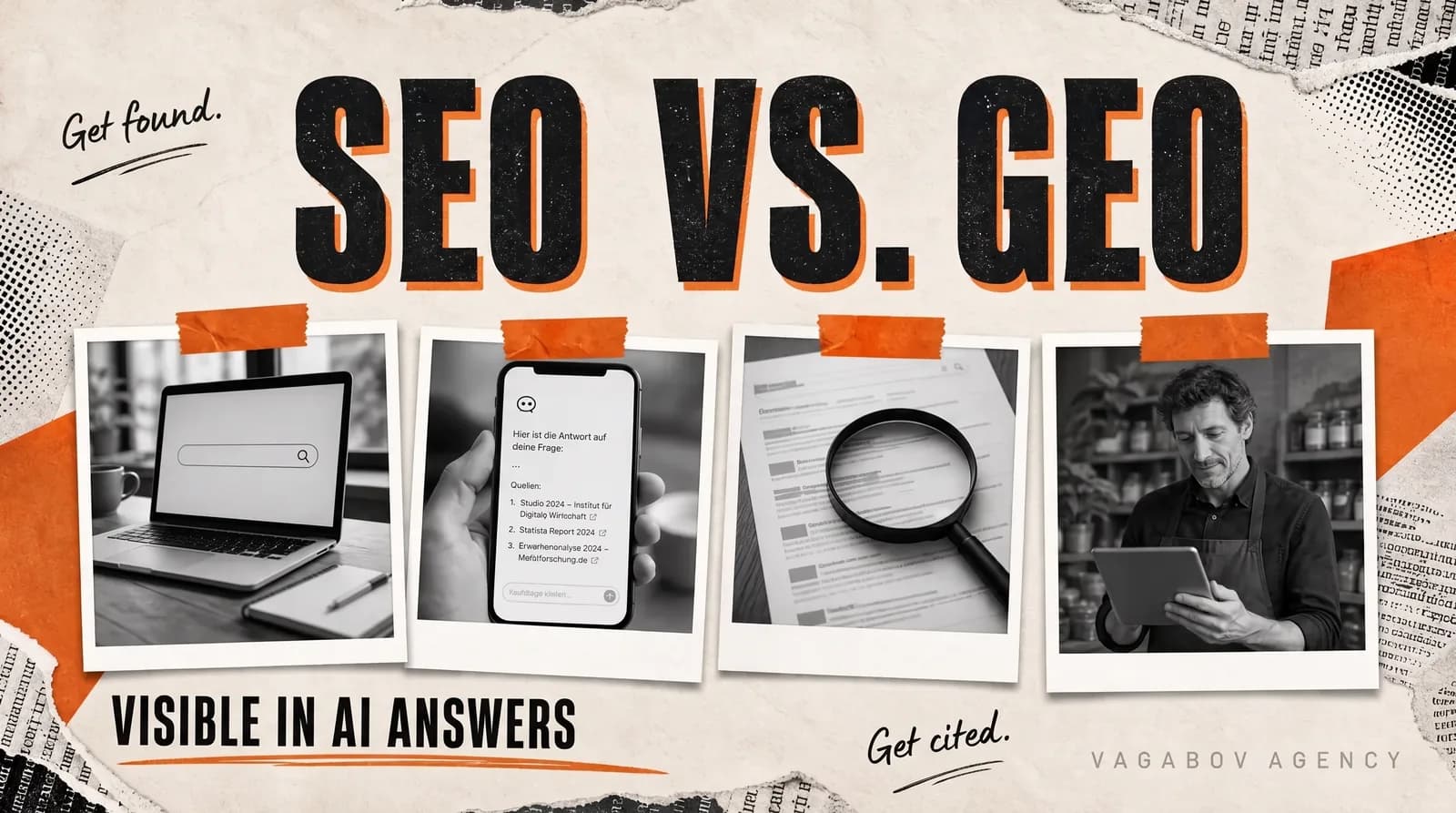
I’ll put it plainly: if you only optimize for the classic list of Google results today, you are giving away visibility. Not because Google is disappearing — but because more and more people get their answer without clicking on a website at all.
Back in 2024, before Google’s AI Overviews were available in Germany, almost 60% of Google searches in the EU ended without a single click, according to a study by SparkToro and Datos. Since then, AI Overviews and Google’s AI Mode have arrived, and more and more people ask ChatGPT, Perplexity or Claude directly. All of these services deliver a ready-made answer, usually with a few sources alongside. If your website isn’t among those sources, the person asking may never find out that you exist.
That is what GEO — generative engine optimization — is about. The term sounds like a buzzword, but it describes a very practical question: how does your website become a source that an AI cites or recommends?
SEO vs. GEO: two worlds, one goal — but different rules
Classic SEO follows a familiar pattern: research search terms, write helpful content, keep the technical side clean, earn links from other sites — and work toward Google showing you near the top. That still works. Searchers see a list and decide for themselves what to click.
AI search works differently. Whether it’s Google AI Mode, ChatGPT or Claude, the end result is not a list but a summarized answer. The sources sit off to the side and get only part of the attention. So the question is no longer just “What position am I in?” but “Am I mentioned at all?”
| Criterion | Classic SEO | GEO |
|---|---|---|
| Result | A list of results | A summarized answer with a few sources |
| Goal | A good position and a click to your site | Being cited as a source or recommended as a provider |
| What matters | Relevance, technical quality, links | The same — plus clear, quotable statements and mentions of your brand across the web |
| Measurability | Rankings, clicks, Search Console | Harder: mentions in AI answers, visits from AI services |
A common fallacy: “I’m on page 1 for my search terms, so I’ll show up in AI answers too.” That may be the case, but it doesn’t have to be. Google itself describes how AI Overviews and AI Mode can use what is called query fan-out: several related searches on subtopics run in the background, and the answer is assembled from their results. So a page that only ranks on page 2 for the main term can appear as a source because it answers one sub-question particularly well. And a page in position 3 is left out if it only says general things.
The good news is in the same Google documentation: there are no additional technical requirements for the AI features in Google Search. A page has to be indexed and eligible to be shown with a snippet; the familiar SEO basics still apply. So GEO doesn’t replace SEO — it builds on it.
The three pillars of AI visibility
No provider fully discloses what exactly decides whether an AI cites you. But from the official guidance and the research so far, you can derive three areas where the work pays off.
1. Brand depth instead of keyword density
Language models don’t count how often a term appears on your page. What they know about you comes from everything that can be found about you across the web — and in live search, they draw on sources they consider trustworthy. That’s why it matters how well established your brand is outside your own website, too:
- Are you mentioned by name in trade articles, regional media or industry portals?
- Do your name, address and phone number match everywhere — on your website, in your Google Business Profile, in directories?
- Are there interviews, guest articles or talks in which you appear as the go-to person for your topic?
- Have customers reviewed you publicly and verifiably?
Keyword stuffing, on the other hand, doesn’t help. In the study that coined the term GEO (Aggarwal et al., presented at KDD 2024), keyword stuffing brought practically no improvement in AI answers.
2. Structured data: helpful, but not an entry ticket
You often read that without Schema.org markup, a website is invisible to AI. That’s not quite right. Google states explicitly that you need neither special markup nor dedicated AI text files for AI Overviews and AI Mode. Language models understand well-written running text very well.
Structured markup still makes sense, though. JSON-LD tells search engines unambiguously who you are and what you offer: business name, address, opening hours, services, the author of an article. It is the basis for rich results in regular search and makes it easier for machines to attribute information correctly. Two things matter here: the markup has to match the visible content. And it has to be in the HTML the server delivers rather than loaded later via JavaScript — many AI crawlers don’t execute JavaScript and see only what the server sends directly.
3. Topical depth instead of isolated pages
For a long time, the SEO rule was: one page, one keyword. For AI answers, what counts more is whether your website really covers a topic — with answers to the follow-up questions people actually ask. These sub-questions are exactly what query fan-out searches for in the background.
An example: if you offer web design, a single “Webdesign Koblenz” (web design Koblenz) page is hardly enough. A small network of topics works better: the service page, an article on costs, one on the process, one comparing buying and renting, plus an FAQ section — all sensibly linked to each other.
This fits a second finding of the GEO study: content with quotations, concrete numbers and source citations became much more visible in the generated answers — by up to about 40% under test conditions. For your texts, that means fewer empty phrases and more facts that can be quoted: prices, processes, time frames, conditions, verified numbers with a source.
ChatGPT, Claude and co.: search beyond Google
Google’s AI features are only part of the story. According to OpenAI, hundreds of millions of people use ChatGPT alone every week, and then there are Claude, Perplexity and Gemini. People ask them things like “Welche Agentur in der Region Koblenz macht KI-Werbevideos?” (Which agency in the Koblenz region makes AI ad videos?) or “Lohnt sich ein Website-Abo für einen Handwerksbetrieb?” (Is a website subscription worth it for a trade business?) The AI then gives a few names. Yours may not be one of them.
These systems get their knowledge in two ways:
- Training data: whatever was publicly available about you on the web at the time of training. New information only arrives here with later model versions, so with a considerable delay.
- Live search: For many questions, the system searches the web in real time and links to its sources. For that, your website has to be accessible to the relevant crawlers and deliver its content directly in the HTML.
One detail that is often overlooked is the robots.txt file. Some plugins, firewalls or CDN settings block AI crawlers across the board. That can be a deliberate decision — it just shouldn’t happen by accident. You can also differentiate: OpenAI, for example, distinguishes between GPTBot, which collects content for training, and OAI-SearchBot, which handles search in ChatGPT. If you don’t want to end up in training data but do want to appear in ChatGPT search, you can block one and allow the other.
What you can do right now
No panic, but no waiting either. These steps are a good starting point — most of them pay into classic SEO at the same time:
- Check the technical foundation. Are your important pages indexed? Is the content in the HTML the server delivers? Does the page load quickly? For the Core Web Vitals, these values count as good: LCP up to 2.5 seconds, INP up to 200 milliseconds, CLS up to 0.1. More on this in the article on technical SEO and Core Web Vitals (in German).
- Add structured data. Organization or LocalBusiness for your business, Service for your services, Article for blog posts, BreadcrumbList for navigation — always matching the visible content. Google’s Rich Results Test shows you whether everything is recognized.
- Check your robots.txt. Which crawlers are you blocking — and is that intentional?
- Write so you can be quoted. Answer your customers’ questions directly, ideally in the very first sentence of a section. State prices, time frames and conditions, and back up numbers with sources. An AI would rather quote one clear sentence than three paragraphs of marketing speak.
- Build topic clusters. Choose three to five core topics you want to be found for. For each topic: a strong service page plus articles and FAQs that answer the follow-up questions — all linked to each other.
- Strengthen your brand beyond your website. A complete Google Business Profile, consistent listings in relevant directories, guest articles or interviews in trade and regional media, genuine reviews. Incidentally, a Wikipedia article is not a realistic goal for most small businesses: Wikipedia has strict notability criteria and frowns on articles about your own company.
- Test it yourself. Regularly ask ChatGPT, Perplexity, Claude or Gemini the questions your customers would ask. Note who gets mentioned and which sources are linked. It isn’t an exact measurement, but it shows you where you stand and what is changing.
This is not a sprint; it’s groundwork over months. The upside: you don’t do anything twice. Whatever makes you quotable for AI answers also makes your website better for people and for classic search.
Next step
If you want to know how your website currently performs in Google and in AI answers, let’s look at it together in a free 30-minute initial call. Afterward, you’ll know which two or three measures give you the most leverage.