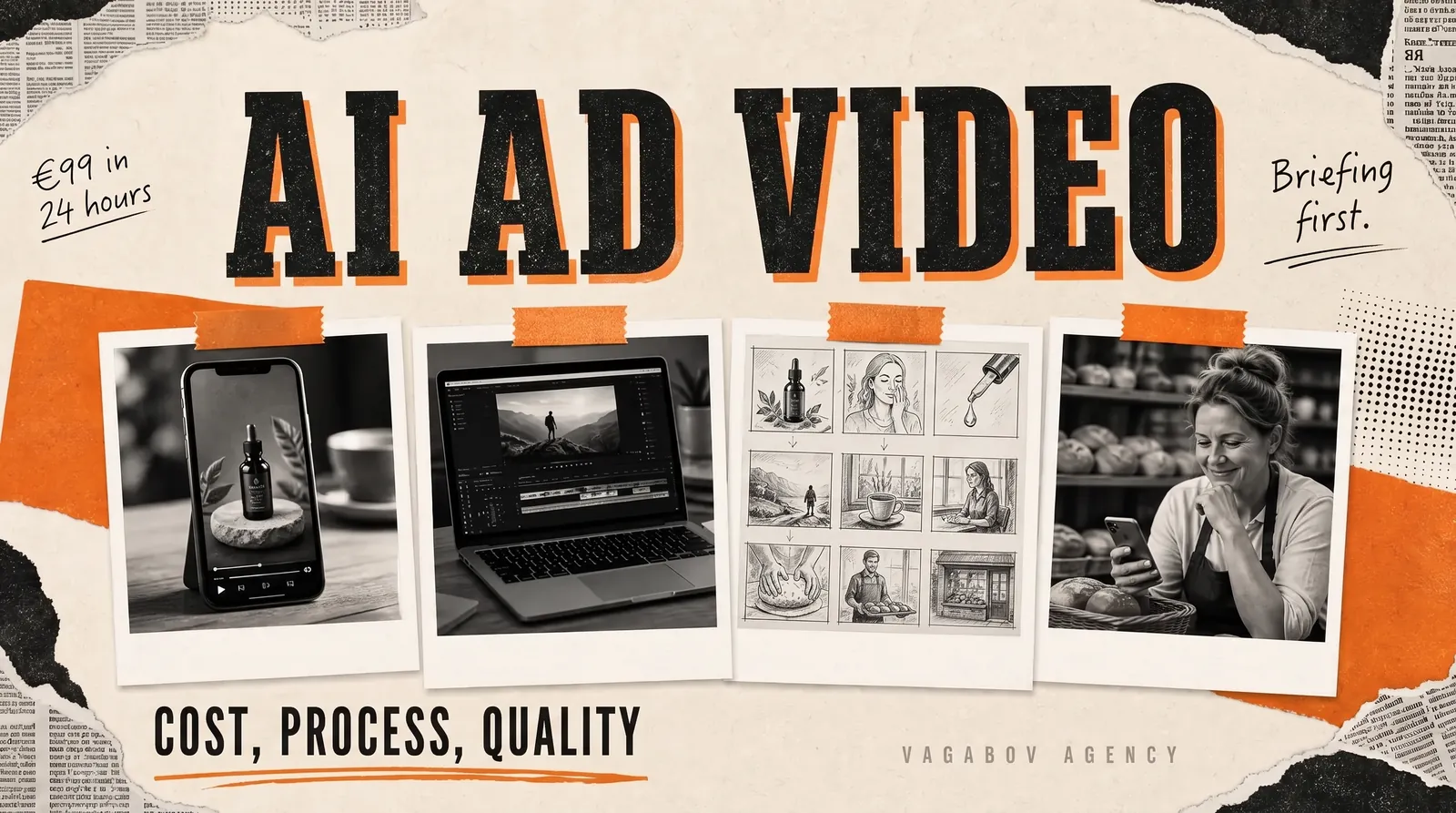
€99, delivered in 24 hours — this is how our fixed-price AI ad video works. There is often a world of difference between the promises you read online and what ends up on the screen. If you want to create an AI ad video, you need more than the right tool: you need a clear brief, a fixed process and a realistic idea of the result. Having produced more than 150 videos, I know where AI video convinces today and where it still falls short. Here is an honest overview of costs, process, quality and suitable platforms.
What does an AI ad video really cost?
Prices quoted online range from “free” to several thousand euros. What matters is less the tool than the question of who does the work — and what your own time is worth.
Three options at a glance:
- Do it yourself with free credits: Many providers offer free credits or trial periods. That is enough for first experiments. The result is rarely good enough for advertising: faces change between scenes, objects warp, and the visual style looks generic.
- Do it yourself with paid tools: With subscriptions to providers such as Kling or Runway, or with models such as Veo (Google) and Seedance (ByteDance), the quality gets significantly better. The subscriptions cost roughly between ten and more than a hundred euros a month per tool — prices and credit allowances change often, so check the current terms with the provider. The biggest cost item remains your time: without practice in prompting, selecting and editing, a lot of potential goes unused.
- AI ad video at a fixed price: With us, a video costs €99 and is ready within 24 hours. It includes 15 to 30 seconds of video in one format (9:16 or 16:9), script and storyboard, royalty-free music, an optional voice-over in German or English, one round of revisions and full usage rights. If you are not satisfied after the revision, you get your money back. All the details are on vagabov.agency/video.
Costs that are easy to overlook when you do it yourself: music licenses, a voice (a voice actor or an AI voice), subtitles, editing — and above all the hours that go into attempts that never make it into the video. That is how a supposedly free AI video quickly ends up costing more than a fixed price.
How long does it take to produce an AI ad video?
With us, no more than 24 hours after your order. This works because the format is clearly defined — one video, 15 to 30 seconds, one aspect ratio — and because every step is fixed. If you are producing on your own for the first time, it usually takes much longer: the learning curve for prompting, selecting and editing is steep.
How an order works with us:
- Fill in the brief (about 5 minutes): Enter the product, target audience, style and platform, then pay securely via Stripe. You can send your logo, product images or other brand elements after ordering.
- Script and storyboard: We define what happens in the first two seconds (the hook), how the short story unfolds and which call to action ends the video.
- Generation and selection: Each scene is generated several times. The best version goes into the video — not the first hit.
- Editing, sound and text: Timing, transitions, music, optional voice-over, subtitles and text overlays. Where the EU AI Act requires labeling as AI-generated, the label is built in.
- Delivery: You receive the finished video as an MP4 by email — ready to post or to use in your ads.
- Revision: One round of revisions is included. If it still isn’t right after that, we refund the full amount.
Checklist: what to clarify before you order
- One goal per video: More inquiries, more visits to your shop or more awareness? One video, one message.
- The target audience in one sentence: “Homeowners in the Koblenz region who want to modernize their heating” is better than “everyone.”
- Platform and format: 9:16 for Reels, TikTok and Shorts, 16:9 for YouTube, LinkedIn or your website. Each order includes one format.
- The viewer’s next step: Call, book an appointment, open the shop? That becomes the call to action.
- Material: Logo, product photos, colors — and ideally a sample video you like.
- Mandatory information: Prices, promotion periods or legal notices that have to appear in the video.
What quality can you expect in 2026?
In short shots, AI video today is often hard to tell apart from real footage. The limits show in longer scenes, with people and with exact details. The key is to use the technology for what it does well.
What AI video does well:
- Atmospheric product and mood scenes, including ones based on your own photos
- Visual worlds that would be too expensive or simply impossible with a real shoot
- A consistent look across several short scenes that are edited together into 15 to 30 seconds
- Variants for testing — different hooks, different copy, different languages — with manageable effort
Where AI video still struggles:
- Natural facial expressions and subtle gestures in longer shots
- Dialogue between several people
- Long, continuous camera moves without a cut
- Exact product details: small print on labels or logos doesn’t always stay stable in moving images. That is why logos and text are usually added afterwards.
For social media advertising that has to grab attention in the first few seconds, AI video is therefore often a fast and affordable alternative to traditional production. When it comes to real people, your team or your premises, however, there is usually no way around a real shoot. You’ll find a detailed comparison in the article AI video vs. traditional video shoot.
Which platforms is AI video suited for in 2026?
Not every video works everywhere. Format, length and the opening all help decide whether it works.
- TikTok, Instagram Reels and YouTube Shorts (9:16): Vertical video is the natural stage for AI video. Fast cuts and unusual images stand out in the feed — provided the first one or two seconds land.
- YouTube ads (16:9): Skippable in-stream ads can be skipped after five seconds. So your core message and your brand belong at the very start.
- Meta ads on Facebook and Instagram: 9:16 works for Reels and Stories. For feed ads, Meta usually recommends 4:5 or 1:1 — decide in advance where your ad will mainly run.
- LinkedIn (16:9 or vertical): In a B2B setting, clear, calm product and explainer sequences usually work better than loud effects.
- Website (16:9): A short clip in the header can make an offer more tangible. Keep an eye on load time: a heavily compressed file, a poster image, no sound on autoplay.
The bottom line: AI ad video is no longer hype — but it doesn’t run on autopilot
AI video has arrived in marketing. But it doesn’t replace a strategy: if you create “some AI video” without a clear goal, you get generic images. With a clear brief, a strong opening and clean editing, on the other hand, you get an ad asset that is fast, affordable and testable. Also keep labeling in mind: I explain what the EU AI Act means for AI content in advertising in this article.
If you want to try it: you’ll find the process, scope and money-back guarantee of the €99 package on vagabov.agency/video.