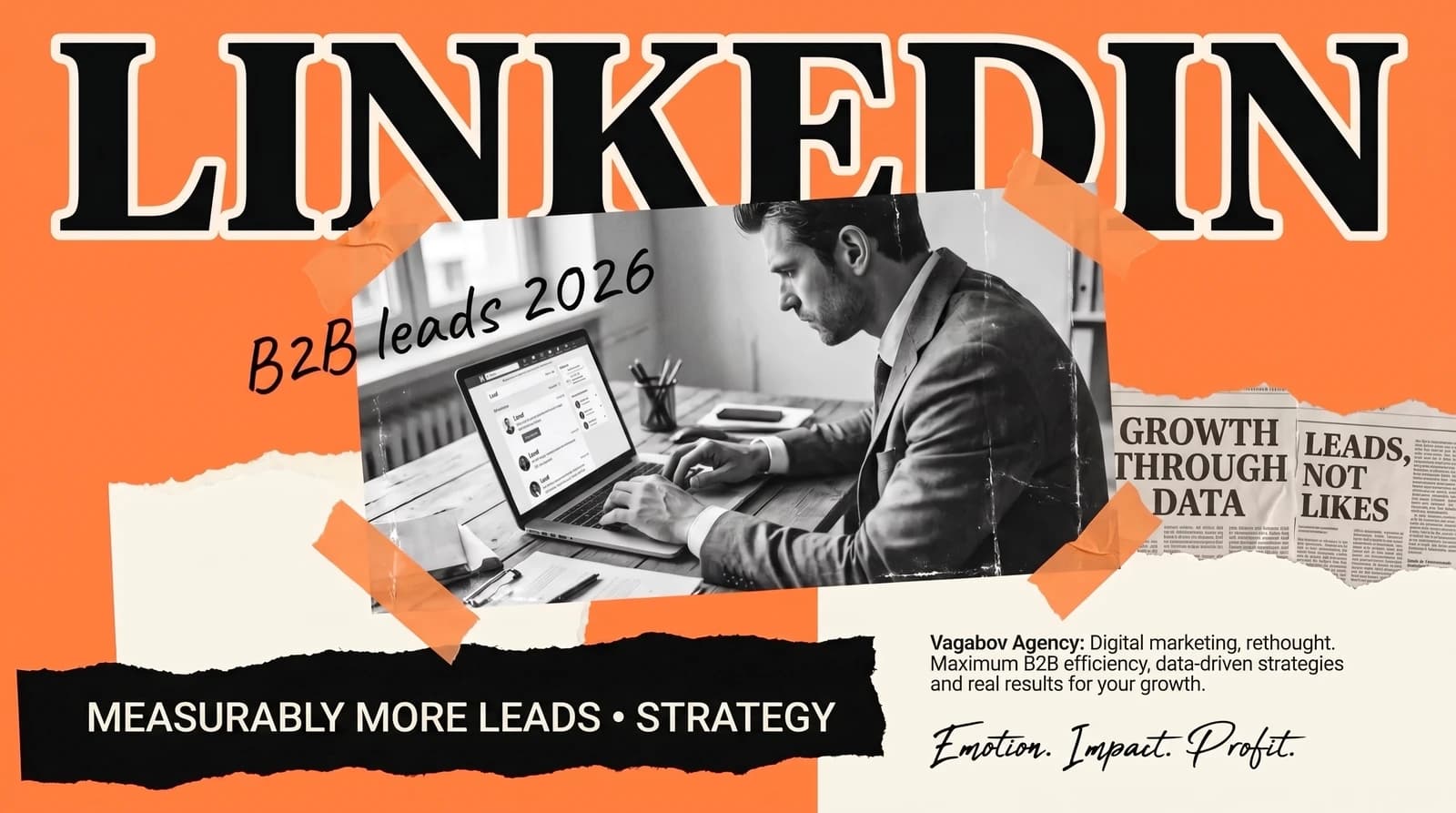
“LinkedIn? I post something there now and then, but it doesn’t bring in any customers.” When I hear this, the problem is rarely the platform; it is the approach. LinkedIn is the central social channel for B2B in the DACH region (Germany, Austria, Switzerland): a large share of professionals and managers have a profile there — with their real name, position and employer, even if far from all of them are active regularly. There is a big difference, though, between “posting now and then” and a well-thought-out LinkedIn strategy. That difference is what this article is about.
Why LinkedIn is hard to replace for B2B in 2026
Instagram and Facebook are strong if you want to reach consumers. TikTok thrives on entertainment. LinkedIn, on the other hand, is where people show up in their professional role: they read expert posts, keep an eye on their industries and look for service providers and employees. Whatever you publish here reaches an audience that is thinking about work at that moment.
On top of that, LinkedIn has been emphasizing for some time that it favors posts with genuine expertise and concrete advice — rather than pure self-promotion. For small and medium-sized businesses, that is good news. You don’t have to be louder than the corporations, just more specific. And your target audience is visible here with name, position and company. That makes LinkedIn more than a social media channel: it is a directory of your potential customers with built-in reach.
The LinkedIn company page: more than a business card
Many company pages on LinkedIn look abandoned: a logo, a description from five years ago, three posts in the past year. Yet the page is the first port of call for anyone who wants to know more about you after a post or a conversation. Here is how to bring it up to date in an hour:
- Logo and cover image: A sharp logo and a cover image that shows at a glance what you do and for whom. The cover image is your billboard — use it for a clear value proposition instead of a stock photo.
- The right button: Company pages can have their own call-to-action button with a custom URL, for example for contact, registration or “Learn more.” Link to the page that matches the action, not simply to your homepage. According to LinkedIn Help, however, without a paid Premium Company Page the button only appears in the “More” menu.
- A meaningful About description: Visitors read the first sentences first, and they often appear in search engines too. Put your core promise and the terms your customers search for at the beginning.
- Complete details: Fill in industry, company size, location, website and services. Ask your team to link their own profiles to the company page — that shows who is behind the company.
By the way: LinkedIn no longer offers lead forms directly on company pages. Forms with pre-filled profile data are still available, though: as a registration form for events you host through your company page, and in combination with ads — more on that below.
Content strategy: what really works on LinkedIn in 2026
There are no fixed formulas for reach on LinkedIn, and the algorithm keeps changing. But a few patterns have proven themselves:
Personal profiles before the company page: In practice, posts from individuals usually reach significantly more people than posts from company pages. People follow people. For small businesses, this means the managing director or experts on the team post under their own names, and the company page shares and adds to those posts.
Text posts with substance: Posts that pick up a specific problem your target audience has and show a way to solve it right away work better than announcements. Many observations suggest that posts with an external link get less reach — LinkedIn wants to keep users on the platform. In practical terms: write the full content into the post and add a link only where it is really necessary.
Document posts: An uploaded PDF is displayed as a presentation that people can click through. This works well for checklists, step-by-step guides or short case studies — for example “5 Fehler bei der B2B-Kaltakquise” (5 mistakes in B2B cold outreach) on eight to ten pages. Upload the PDF directly instead of just linking to it.
Video: Upload videos directly to LinkedIn instead of sharing YouTube links. Keep them short and add subtitles — many people watch at the office or on the go without sound.
Rhythm: For most small businesses, two to three posts a week are realistic. More important than the exact number is that you keep at it: if you stick with it for three months, you learn more about your target audience than someone who posts daily for a week and then stops. As a starting point for the mix, I suggest about 40% expertise, 30% project stories and experiences, 20% insights into your industry and day-to-day work, and 10% direct self-promotion.
LinkedIn Ads: the underrated precision tool for B2B
LinkedIn Ads are more expensive than ads on Meta, but more precise. Instead of targeting by interests, you select by professional characteristics: job title or function, company size, industry, seniority, even specific companies via an uploaded list. This lets you reach, for example, purchasing managers at mechanical engineering companies with 50 to 500 employees. There is one limit: an audience must include at least 300 members. So targeting a handful of dream clients individually doesn’t work.
The most important formats:
- Sponsored Content: Posts that run as ads in the feed — as an image, video, carousel or document. Ideal for amplifying content that already performs well organically. With so-called Thought Leader Ads, you can also promote posts from personal profiles, such as your managing director’s.
- Message Ads and Conversation Ads: Sponsored messages delivered straight to the inbox. In the DACH region, this format is heavily restricted: after a long pause, LinkedIn has been delivering such messages in the EU again since fall 2024 — but only to members who have explicitly agreed to receive them (LinkedIn Help). As a result, the audience you can reach is much smaller.
- Lead Gen Forms: Forms that LinkedIn pre-fills with profile data. Anyone who clicks on the ad doesn’t have to type anything — the hurdle is lower than with an external landing page. You need a link to your privacy policy for this, and you should follow up with the contacts quickly while their interest is fresh.
On budget: clicks on LinkedIn are usually much more expensive than on Meta. For a first meaningful test, I would plan €500–1,000 per month, test two to three audiences with two ad variants each, and then expand what works. LinkedIn Ads are not a sprint — expect two to three months of ongoing optimization before you can make a reliable judgment.
Sales Navigator: your B2B radar for warm leads
LinkedIn Sales Navigator is a paid sales tool. Prices depend on the version and billing period and change regularly — it’s best to check the current pricing directly with LinkedIn. In return, you get advanced search filters (for example by industry, company size, position or recent job change), lead recommendations, notes on contacts and alerts when something happens with saved contacts and companies.
Don’t use Sales Navigator for mass cold messaging; use it as a research tool: find the right contact people, follow what they post and comment on, and only get in touch when there is a genuine point of connection — a post, a job change, a question you can answer. One personal message with a real reference point achieves more than ten copy-and-paste requests.
How to start: a plan for the first 90 days
- Weeks 1–2: Revise your personal profile and company page — photo, cover image, About text, button, services.
- Weeks 3–4: Define three to five topics you really have something to say about, and set up a simple content calendar.
- Month 2: Publish two to three posts a week, leave thoughtful comments on posts by others in your industry and grow your network in a targeted way.
- Month 3: Evaluate which topics and formats spark conversations. Only then decide whether an ad test or Sales Navigator is worth it.
In B2B, LinkedIn marketing is not a nice-to-have, but it doesn’t run by itself either. If you approach it strategically, you can build qualified contacts in the DACH region through it — but no one can credibly promise you guaranteed leads. The question is less whether LinkedIn works and more whether you give the platform enough time and substance.
If you don’t want to handle LinkedIn alone: in our social media packages, LinkedIn is one of the platforms you can choose — with a content calendar, content and monthly reporting.